Ensure Your Project Meets New Radon Code Requirements. If you’re a builder in Clark County, Washington, radon testing is no longer optional – it’s mandatory. Recent code changes mean all new homes in high-radon areas (EPA Zone 1) must incorporate radon-resistant construction features and pass a radon test before completion. Performance Insulation & Energy Services is here to help you stay compliant and protect homeowners’ health with professional radon testing services.

source: Environmental Protection Agency
Clark County Radon Code Timeline & Requirements
New radon control rules are being enforced in Clark County to reduce lung cancer risk and comply with state building codes. Below is a timeline of the key changes and what they mean for builders:
2023: Clark County reviewed local radon risk data and prepared amendments to adopt IRC Appendix AF (Radon Control Methods) for new residential construction. This set the stage for adding radon-resistant building requirements into the local code.
January 2024: Clark County announced upcoming enforcement of radon control requirements for homes built in EPA Zone 1 radon areas (areas with highest radon potential). Builders were alerted that new homes in designated high-radon zones would soon need radon mitigation features and testing.
March 15, 2024: Effective date – Clark County (and all Washington State jurisdictions) officially began enforcing the 2021 International Residential Code (IRC) Appendix AF radon control requirements for new construction. Any building permit applications on or after this date must comply with the radon-resistant construction standards.
Post-March 2024: All new residential construction in Clark County must include radon mitigation provisions and testing, including:
Soil-gas retarders: A radon-resistant barrier (plastic sheeting) installed under concrete slabs or crawlspace vapor barriers to reduce soil gas entry.
Vent pipe installation: A vertical vent pipe running from the foundation gravel up through the roof (passive radon system) to safely vent radon gas outdoors.
Electrical junction box: An electrical box wired near the vent pipe in the attic, ready for a radon fan installation. This allows easy activation of the system if high radon levels are detected.
Mandatory radon testing: A post-construction radon test must be conducted in each new home before occupancy. This test determines if the passive system is keeping radon below safe levels.
Fan installation & retesting if ≥4.0 pCi/L: If the radon test result is 4.0 pCi/L or higher (at or above the EPA action level), a radon vent fan must be installed to actively pull radon from beneath the house, and the home must be re-tested until levels fall below 4.0 pCi/L.
Radon Testing Procedure for New Homes
Under the new code, radon testing is a critical final step in the construction process. According to Section AF104.1 of the Washington Residential Code (Appendix AF), “where radon-resistant construction is required, radon testing shall be [performed] as specified” by detailed guidelines. In practice, this means:
Timing of the Test: The radon test is done after the home’s construction is essentially complete. The code requires testing only after the dwelling passes its air tightness (blower door) test and all HVAC and radon system components are installed and operational. In other words, the house should be in its final condition with ventilation systems running as normal during the test.
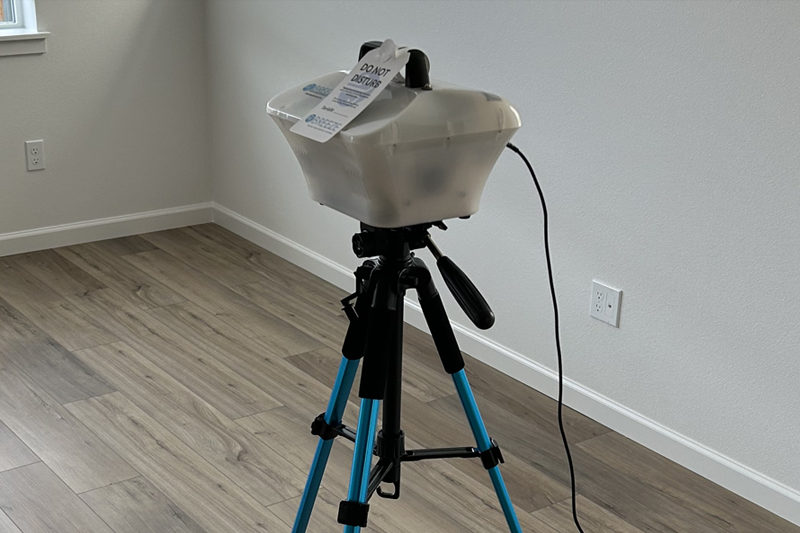
Test Conditions: For a valid result, the test must be conducted under closed-building conditions. All windows remain closed (and doors kept closed except for normal entry/exit) for at least 12 hours before and during the test. The test is placed at the lowest occupied level of the home (such as the basement or first floor) and runs for a minimum of 48 hours. This can be done with either two passive radon test kits (charcoal canisters) whose results are averaged, or with a continuous radon monitor operated by an approved third party – such as our certified professionals.
Who Can Perform Testing: The code allows the builder, a registered design professional, or an approved third-party to perform the radon test. Many builders choose qualified third-party testers (like Performance Insulation & Energy Services) to ensure accuracy and to avoid any conflicts of interest. Our team uses calibrated continuous radon monitors for fast, reliable results, so you don’t have to wait long to get the data needed for your final inspection.
Interpreting Results: Once the test is complete, written radon test results must be provided. If the measured radon level is below 4.0 pCi/L, the final test report can be submitted to the building code official as proof the home meets the requirement. If the radon level is 4.0 pCi/L or greater, however, the code mandates further action: the passive system’s vent pipe must be upgraded with a fan (to actively vent radon) and the house must be retested until the results are below 4.0 pCi/L. In other words, a new home isn’t cleared for occupancy until it demonstrates safe radon levels. This protects homebuyers by ensuring high radon is addressed upfront, not left as a surprise later.
Your Certified Radon Testing Partner
Why choose Performance Insulation & Energy Services for radon testing?
We are not new to building performance – for years, we’ve been the Pacific Northwest’s specialists in insulation, air sealing, and energy code compliance testing. Our team understands how to make buildings safe, healthy, and efficient. Now, as a Certified Radon Measurement Professional (NRPP), we bring that same expertise to radon testing. The National Radon Proficiency Program (NRPP) certification is recognized by the EPA as a mark of qualified radon expertise. It indicates our technicians have mastered the skills required to reliably conduct radon testing in homes. We follow rigorous protocols and use professional-grade testing equipment, so you can trust the results.
Builder-Focused Service:
We know timelines are tight and quality is non-negotiable. Our radon testing service is designed with builders in mind: we coordinate scheduling to fit your project’s timeline (performing the test immediately after your final air tightness/blower door test and HVAC startup), and we maintain closed-house conditions properly to get an accurate reading. If your project requires activation of the radon system (installation of a fan) due to high results, we’ll notify you immediately and can assist in coordinating the next steps, including retesting after mitigation. Throughout the process, we document everything and provide you with the report needed for the building inspector.
Reputation for Excellence:
Performance Insulation & Energy Services has built an exceptional reputation for quality and customer satisfaction. We are proud to be a trusted partner to builders across the region. Our expansion into radon testing is a natural extension of our commitment to whole-house performance. By handling insulation, air sealing, blower door testing, and now radon testing, we offer a one-stop solution to help ensure your new homes are safe, efficient, and code-compliant. You can count on our certified team to deliver accurate results and professional service every step of the way.
Frequently Asked Questions about Radon
What is radon and why is it dangerous?
Radon is a naturally occurring radioactive gas that comes from the breakdown of uranium in soil and rocks. It’s colorless, odorless, and invisible, so the only way to detect it is through testing. Radon gas can seep into buildings through foundations and accumulate in indoor air. Long-term exposure to high levels of radon is dangerous because it can cause lung cancer. In fact, radon is the #1 cause of lung cancer among non-smokers and the second leading cause of lung cancer overall (after smoking), responsible for an estimated 21,000 lung cancer deaths in the U.S. each year. This is why health authorities and building codes are increasingly focused on preventing radon exposure in homes.
How does radon get into a new house?
Radon gas moves up from the soil and enters buildings through small cracks or openings in the foundation, walls, and floors – even in brand new homes. Common entry points include cracks in the concrete slab or foundation, gaps around pipes or wires, sump pits or drains, and crawlspaces. New homes are often built tightly for energy efficiency, which can actually allow radon to accumulate more if it gets in. That’s why the building code now requires radon-resistant construction features (like a beneath-slab gas retarder and vent pipe) to block and vent radon. The mandatory radon test at the end of construction then confirms whether these measures are keeping radon levels low.
Is radon really a problem in Washington State?
Yes! While radon levels vary, there are several parts of Washington that have significant radon potential. The EPA has classified counties into Radon Zones (Zone 1 = highest potential). Clark County is designated Zone 1, which means the average indoor radon level in the area is predicted to be above 4 pCi/L (the EPA’s recommended action level). Eastern Washington has many Zone 1 areas as well – for example, Spokane County and others have a history of high radon readings. Even some spotty areas in western Washington (beyond just Clark County) can have elevated radon due to local geology. In short, radon is definitely present in Washington, and if you’re building in a high-risk zone, it’s now required (and prudent) to build with radon mitigation in mind. However, radon can be uneven – one house might have high levels while a neighboring house is low – which is why testing each home is so important.
What are EPA Radon Zones?
The EPA’s Map of Radon Zones is a general guide highlighting which areas of the country are prone to higher indoor radon levels. Zone 1 (colored red on the map) indicates the highest radon potential – counties where the average indoor screening level is predicted to be above 4.0 pCi/L. Zone 2 (orange) indicates moderate potential (predicted average between 2 and 4 pCi/L), and Zone 3 (yellow) indicates lower potential (average below 2 pCi/L). These designations help building authorities decide where radon-resistant construction might be needed. Clark County, WA is a Zone 1 area, as are many counties in the inland Northwest. Keep in mind, though, that the EPA recommends testing all homes, regardless of zone, because radon levels can vary locally and even a Zone 3 area could have an individual house with high radon.
What radon level is considered safe or acceptable?
There is no completely “safe” level of radon – any amount has some risk – but there are guideline levels for taking action. The EPA’s action level is 4.0 pCi/L (picocuries per liter). If a home’s radon concentration is at or above 4.0 pCi/L, the EPA strongly recommends taking steps to reduce it, because long-term exposure at that level poses a significant health risk. In fact, Washington’s building code uses this number as the cutoff for requiring active mitigation in new homes (installing a fan, etc., if the post-construction test is ≥4.0 pCi/L). The EPA also suggests you consider fixing the home if radon levels are between 2.0 and 3.9 pCi/L, since even moderately elevated levels carry some risk. In new construction, the goal is to have radon as low as feasible; with current methods, it’s very achievable to get levels under 4.0 and often close to the outdoor background (~0.4 pCi/L).
What does the code require for radon testing in new homes?
In high-radon areas like Clark County, the 2021 WA Residential Code Appendix AF now requires that every new house be tested for radon after construction is completed. The testing must follow specific protocols: the test lasts at least 48 hours, under closed-house conditions, on the lowest floor, after all construction and HVAC work is done. The results have to be documented. If the result is below 4.0 pCi/L, no further action is needed other than submitting the report to the building official. If the result comes out at 4.0 pCi/L or higher, the code requires the builder to install an active radon mitigation fan on the vent pipe (if not already installed) and then perform a re-test to ensure the level drops below 4.0. Essentially, the house cannot receive final approval until it demonstrates radon levels under the action level. This testing requirement is now a standard part of closing out a new residential build in affected parts of Washington.
Can I perform the radon test myself as a builder, or do I need a professional?
The code does allow builders to conduct the radon test themselves in new construction, but it must be done according to the specified procedures and devices. In practice, many builders prefer to use a certified radon testing professional for accuracy and convenience. A professional (like our NRPP-certified team) has calibrated continuous radon monitors and expertise in placement and protocol, which helps ensure the test is done right the first time. Professionals also provide a clear, written report of the results – which is exactly what the code official will want to see. By hiring a certified third party, you as the builder gain confidence that the results are objective and reliable. Plus, it saves you time: we handle the setup, pickup, and reporting while you focus on other aspects of the project. Given that a failed radon test requires mitigation work and retesting, it’s critical to get an accurate measurement. We help you avoid delays by delivering fast, trustworthy results and guidance on next steps if mitigation is needed.
Do existing homes in Washington need to be tested for radon?
While the law does not mandate radon testing in existing homes (the requirements we’ve been discussing apply to new construction), it’s highly recommended that all homeowners test their houses for radon. Radon is a hidden hazard. You wouldn’t know it’s there without a test. Many county health departments and the EPA suggest testing your home at least once, and retesting if you significantly renovate or alter your home’s ventilation. In real estate transactions, radon testing is often done during inspections as well. For existing homes in high-risk areas (like much of Clark County or Spokane), testing is especially important. The good news is that if a home does have high radon, it can usually be fixed with a retrofit mitigation system (adding a vent fan or other measures). Whether new or old, every home should be tested at least once for radon. It’s inexpensive and could protect your family’s health.
How can I get my project's radon test done with Performance Insulation + Energy Services?
It’s easy – just call our Radon Testing team at (971) 762-3141 ( and we’ll take care of the rest! We strive to schedule radon tests promptly, so your project stays on timeline. Our team will come out to your site at the appropriate stage (usually right after final mechanicals are in and the house is closed up) to set up the test. After the 48-hour test period, we retrieve the equipment and provide you with the results immediately (our continuous monitors give instant readings). We’ll explain the report to you and answer any questions. If the result is under 4.0 pCi/L, you’ll get a written report to hand over to the inspector and you’re all set. If the level is 4.0 or above, we’ll advise on mitigation and can arrange for a quick retest after mitigation. We’ll work with you until the home passes. Throughout the process, our goal is to make radon compliance hassle-free for you as the builder.
Contact Us for Radon Testing
Ready to ensure your new build meets the radon requirements? Get peace of mind and avoid delays by scheduling a radon test with Performance Insulation & Energy Services. Our dedicated Radon Testing team is here to serve builders in Clark County and beyond. Call us today at (971) 762-3141.
At Performance Insulation & Energy Services, we’re committed to helping you deliver safe, efficient, code-compliant homes. Don’t leave radon to chance. Let us help you test and certify that your new construction is radon-free. Contact us today to schedule your radon testing service and keep your project moving forward with confidence!
Sources: Recent code updates and radon guidelines have been referenced from the 2021 WA State Residential Code Appendix AF (Radon Control Methods), and EPA radon risk publications. These confirm the mandatory testing requirements and health importance of radon mitigation. Let us put our certified expertise to work for you in navigating these new requirements. Your project and your future homeowners will be glad you did.